NeurIPS 2025  ·  Poster

ParamMute: Suppressing Knowledge-Critical FFNs for Faithful Retrieval-Augmented Generation

RAG models still ignore correct retrieved evidence when their own memory disagrees. ParamMute finds the feed-forward layers behind this and mutes them.

Pengcheng Huang1 Zhenghao Liu1,∗ Yukun Yan2 Haiyan Zhao2 Xiaoyuan Yi3 Hao Chen2 Zhiyuan Liu2 Maosong Sun2 Tong Xiao1 Ge Yu1 Chenyan Xiong4
1Northeastern University, China 2Tsinghua University 3Microsoft Research Asia 4Carnegie Mellon University
∗Corresponding author

TL;DRWhen a retrieval-augmented LLM contradicts correct retrieved evidence, a narrow band of mid-to-deep feed-forward (FFN) layers is over-activated. ParamMute fully suppresses the eight most implicated layers (the UA-FFNs) of LLaMA3-8B-Instruct and adds a light knowledge-preference adaptation module. Averaged over subsets, context recall rises by +6.17 points on CoFaithfulQA and +54.63 points on ConFiQA over vanilla RAG.

Abstract

Large language models (LLMs) integrated with retrieval-augmented generation (RAG) have improved factuality by grounding outputs in external evidence. However, they remain susceptible to unfaithful generation, where outputs contradict retrieved context despite its relevance and accuracy. Existing approaches aiming to improve faithfulness primarily focus on enhancing the utilization of external context, but often overlook the persistent influence of internal parametric knowledge during generation. In this work, we investigate the internal mechanisms behind unfaithful generation and identify a subset of mid-to-deep feed-forward networks (FFNs) that are disproportionately activated in such cases. Building on this insight, we propose Parametric Knowledge Muting through FFN Suppression (ParamMute), a framework that improves contextual faithfulness by suppressing the activation of unfaithfulness-associated FFNs and calibrating the model toward retrieved knowledge. To evaluate our approach, we introduce CoFaithfulQA, a benchmark specifically designed to evaluate faithfulness in scenarios where internal knowledge conflicts with accurate external evidence. Experimental results show that ParamMute significantly enhances faithfulness across both CoFaithfulQA and the established ConFiQA benchmark, achieving substantial reductions in reliance on parametric memory. These findings underscore the importance of mitigating internal knowledge dominance and provide a new direction for improving LLM trustworthiness in RAG.

Highlights

+6.17
average context recall (ConR) over vanilla RAG on CoFaithfulQA
+54.63
average ConR over vanilla RAG on the out-of-domain ConFiQA benchmark
8 / 32
FFN layers of LLaMA3-8B-Instruct muted ($\lambda=0$), fixed across all datasets
6
open-domain QA sources behind the new CoFaithfulQA benchmark

At a glance

Problem
Unfaithful generation in RAG: the answer contradicts relevant, accurate retrieved context because the LLM falls back on its parametric (internal) knowledge.
Finding
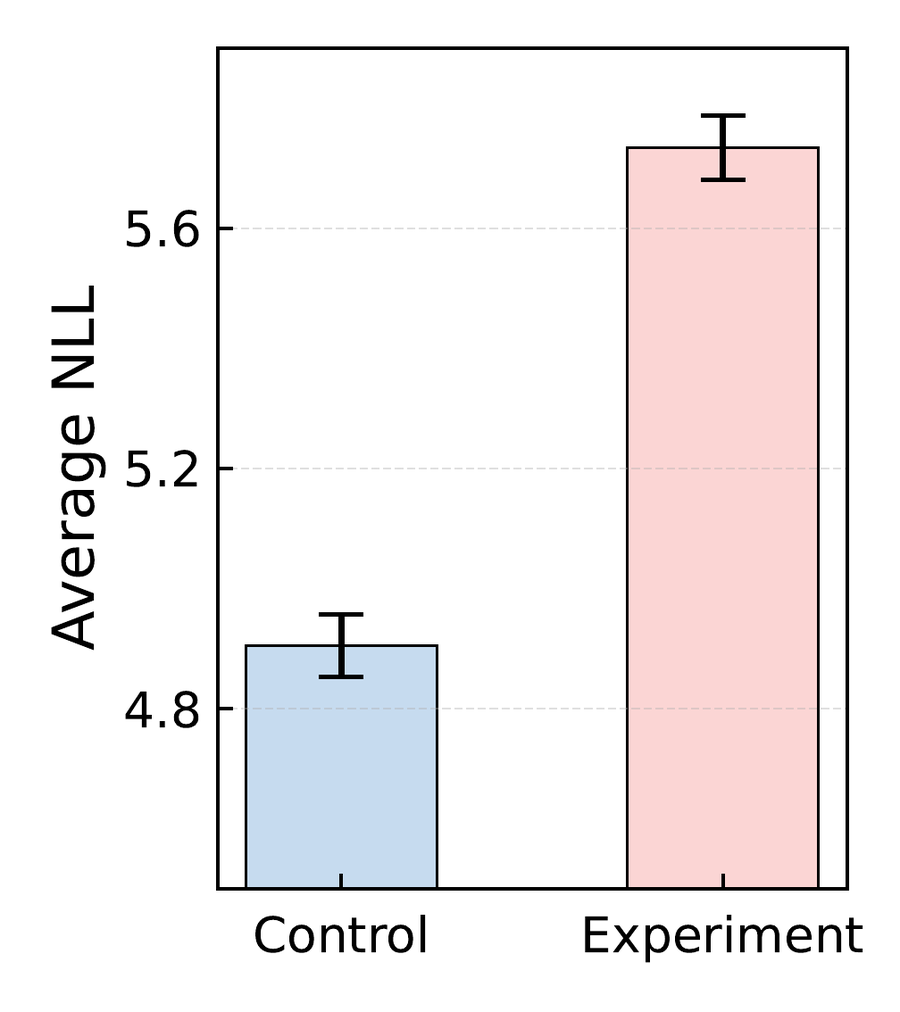
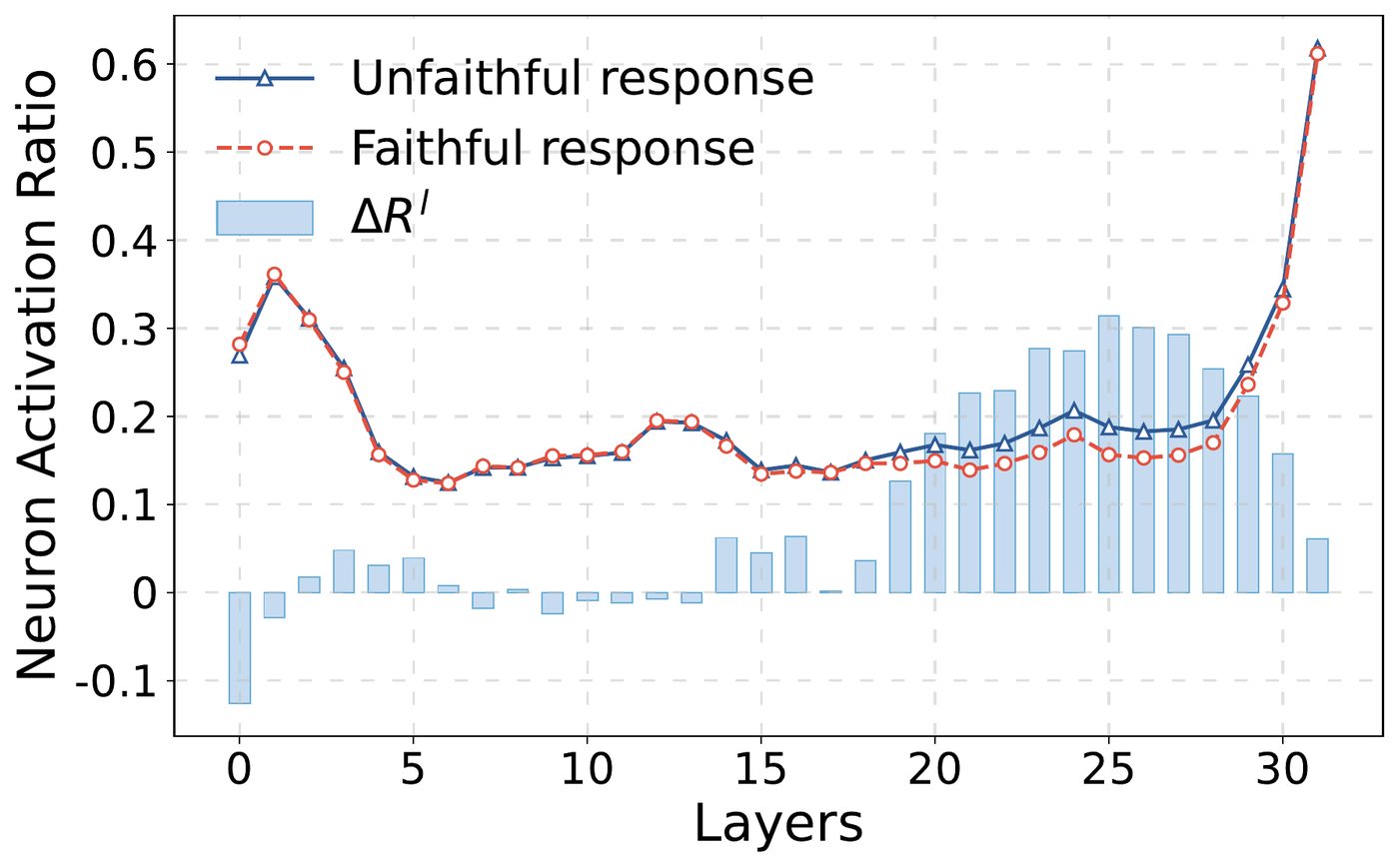
Unfaithful answers coincide with over-activation of a few mid-to-deep FFN layers (Unfaithfulness-Associated FFNs, UA-FFNs); suppressing them makes unfaithful answers less likely (higher NLL).
Method
Two stages: (1) suppress UA-FFN activations with a coefficient $\lambda$; (2) train a plug-and-play adaptation module with knowledge-augmented fine-tuning plus a max-margin knowledge-preference loss.
Benchmarks
CoFaithfulQA (new; natural conflicts from NQ, SQuAD, NewsQA, TriviaQA, SearchQA, HotpotQA), ConFiQA, FaithEval
Main backbone
LLaMA3-8B-Instruct; the appendix extends ParamMute to LLaMA3.2 (1B, 3B) and Qwen2.5 (0.5B to 14B) Instruct models
Venue
NeurIPS 2025 (poster). Earlier arXiv versions were titled PIP-KAG: Mitigating Knowledge Conflicts in Knowledge-Augmented Generation via Parametric Pruning.
Code & data
github.com/OpenBMB/ParamMute · Hugging Face collection (checkpoints, training data, and the benchmark)

Motivation: when internal knowledge wins

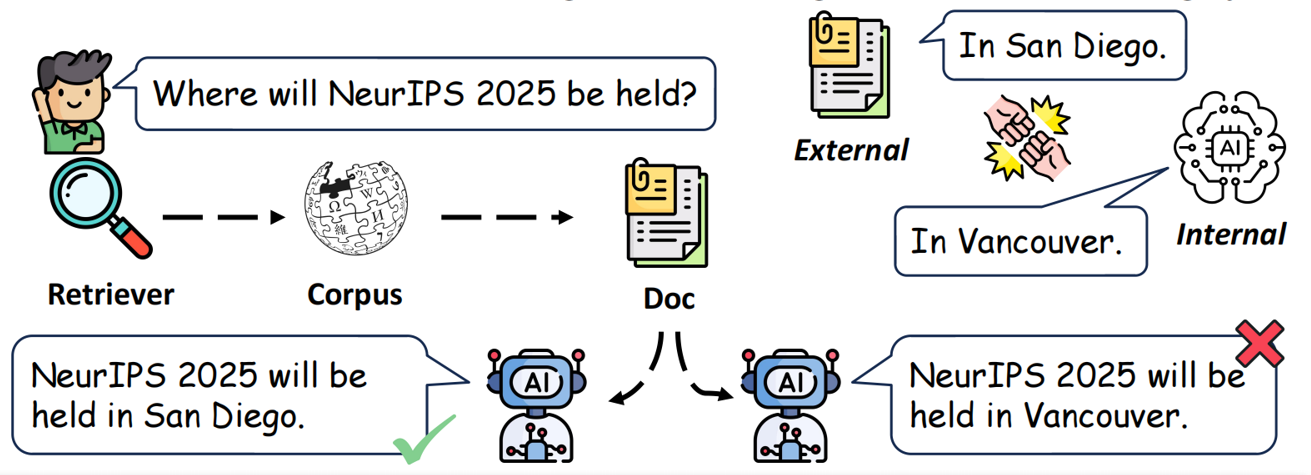
Retrieval should let an LLM answer from up-to-date evidence. In practice the model sometimes trusts what it memorized instead: the retrieved document says one thing, the parametric knowledge says another, and the answer follows memory. Most prior work strengthens the use of external context (prompting, context-aware decoding). ParamMute instead asks where inside the model the competing internal knowledge comes from.

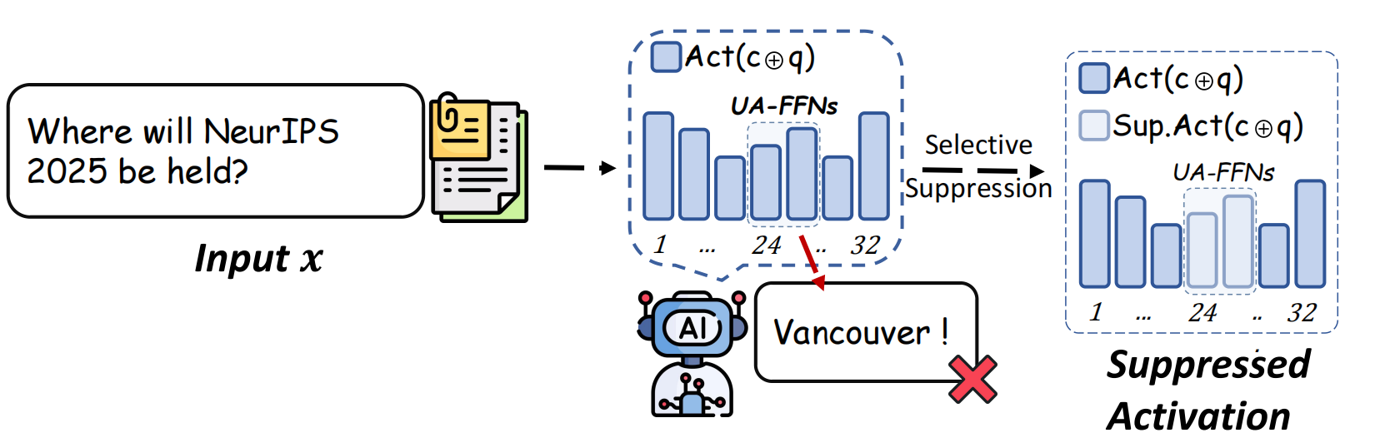
A knowledge conflict in RAG: the retrieved document says NeurIPS 2025 will be held in San Diego, the model's internal knowledge says Vancouver, and an unfaithful model answers Vancouver.
A knowledge conflict. The retrieved document says San Diego; the model's memory says Vancouver. A faithful RAG model should follow the evidence.

Pilot study: unfaithfulness leaves a trace in the FFNs

FFN layers act as key-value memories that store most parametric knowledge. Using the fraction of activated FFN neurons per layer as a proxy for how much internal knowledge is used, we compare faithful and unfaithful responses of LLaMA3-8B-Instruct on CoFaithfulQA.

Layer-wise neuron activation ratio of faithful and unfaithful responses; unfaithful responses are more activated in mid-to-deep layers.
(a) Activation gap $\Delta R^l$: unfaithful responses activate a narrow band of mid-to-deep FFN layers more.
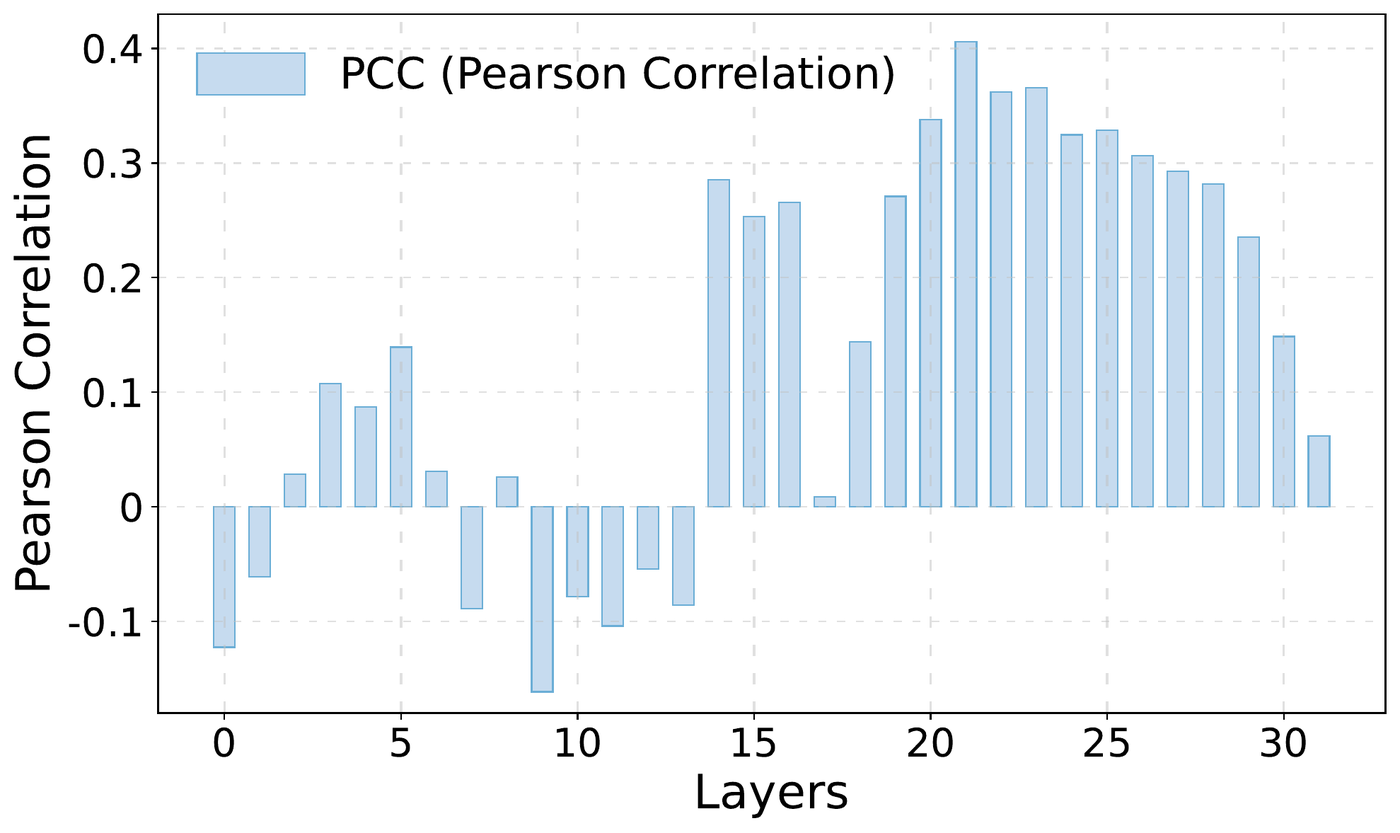
Pearson correlation between layer activation ratio and the unfaithful label, positive in mid-to-deep layers.
(b) Activation in these layers correlates positively with unfaithfulness ($p<0.05$): the UA-FFNs.
Average negative log-likelihood of unfaithful responses rises when UA-FFNs are suppressed.
(c) Suppressing UA-FFNs raises the NLL of unfaithful responses: a causal role.

Method: suppress, then adapt

ParamMute (Parametric Knowledge Muting through FFN Suppression) is a two-stage framework built on the pilot study.

Stage 1

Activation suppression of UA-FFNs

Rank all layers by the activation gap between the unfaithful subset $\mathcal{D}^-$ and the faithful subset $\mathcal{D}^+$, keep the top-$N$ as $L_{\text{sup}}$, and scale their activations by a suppression coefficient $\lambda\in[0,1]$. $\lambda=1$ recovers the original model; $\lambda=0$ removes these FFNs' contribution entirely.

$$\Delta R^l = \mathbb{E}_{\mathcal{D}^-}\big[R^l(\hat r)\big]-\mathbb{E}_{\mathcal{D}^+}\big[R^l(\hat r)\big],\qquad \text{FFN}^l(\mathbf{x}_i^l)=\big(\lambda\cdot\sigma(\mathbf{K}^l\mathbf{x}_i^l)\big)^{\!\top}\mathbf{V}^l \;\;\text{if } l\in L_{\text{sup}}$$
Selective suppression: the over-activated UA-FFN layers around layer 24 of a 32-layer model are suppressed, preventing the wrong parametric answer.
Stage 2

Knowledge-augmented adaptation

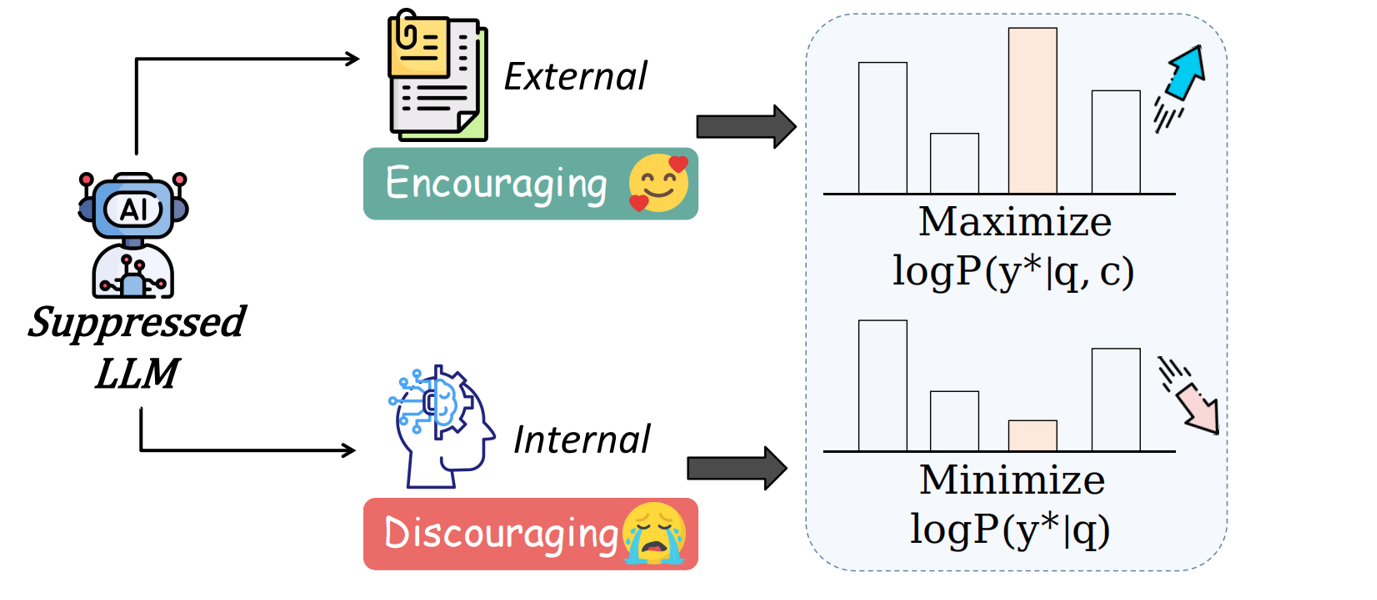
A plug-and-play adaptation module (LoRA-style) is trained on the suppressed model. Knowledge-augmented training rewards the correct answer given the context; knowledge preference optimization is a max-margin loss that prefers answers grounded in the context $c$ over answers the model would give from the query $q$ alone.

$$\mathcal{L}=\alpha\,\mathcal{L}_{\text{KAT}}+\beta\,\mathcal{L}_{\text{KPO}},\quad \mathcal{L}_{\text{KAT}}=-\log P(y^*\mid q,c),\quad \mathcal{L}_{\text{KPO}}=\big[\gamma-\log P(y^*\mid q,c)+\log P(y^*\mid q)\big]_+$$
Knowledge-augmented adaptation: the suppressed LLM is encouraged to maximize log P(y*|q,c) using external knowledge and discouraged via minimizing log P(y*|q) from internal knowledge.

Default configuration: LLaMA3-8B-Instruct backbone, $N=8$ suppressed layers (the same set for every dataset), $\lambda=0$, $\alpha=\beta=0.5$.

CoFaithfulQA: natural knowledge conflicts

Earlier faithfulness benchmarks mostly use synthetic counterfactual contexts that contradict a known-correct answer. CoFaithfulQA (Consistency-filtered Contextual Faithfulness QA) instead captures conflicts that occur naturally between a model's own belief and accurate evidence.

  1. Parametric knowledge elicitation. Ask the model each question closed-book $n$ times and keep its majority answer as its dominant belief; questions whose majority answer appears fewer than $n/2$ times are discarded.
  2. Conflict detection. GPT-4o and GLM-4-plus judge whether that belief conflicts with the evidence and the ground truth; an instance is kept only when both agree. A subset is manually verified.
  3. Labels. Each example carries a faithfulness label, giving a faithful subset $\mathcal{D}^+$ and an unfaithful subset $\mathcal{D}^-$; evaluation uses $\mathcal{D}^-$.
Source dataset#Full (dedup.)#Faithful ($\mathcal{D}^+$)#Unfaithful ($\mathcal{D}^-$)
HotpotQA5,9011,5461,427
NewsQA4,212374886
NQ7,3143,010572
SearchQA16,98010,6921,441
SQuAD10,4902,7992,225
TriviaQA7,7855,887767

The test data is on Hugging Face as chengpingan/CoConflictQA (the benchmark's earlier name).

Experimental results

Metrics: context recall ConR ↑ (answer matches the retrieved context), memory recall MemR ↓ (answer matches the model's parametric answer), and memorization ratio MR = MemR / (MemR + ConR) ↓. All methods use LLaMA3-8B-Instruct.

CoFaithfulQA (in-domain)

MethodHotpotQANQNewsQA
ConRMemRMRConRMemRMRConRMemRMR
Vanilla-RAG60.3413.8818.7053.0914.4121.3560.278.2412.03
Prompting & decoding
Attrprompt58.9313.9519.1355.3611.0716.6758.807.5611.39
O&Iprompt47.7910.7218.3249.258.2314.3252.035.309.25
COIECD62.5112.1916.3256.2112.2817.9351.816.2110.70
Fine-tuning & alignment
SFT70.926.248.0859.7610.2914.6961.965.087.58
KAFT69.526.878.9960.899.2313.1665.094.746.79
C-DPO67.207.6410.2162.249.7913.6061.404.747.17
DDR68.667.159.4363.2910.3314.0364.745.037.21
ParamMute71.066.177.9960.689.0813.0265.244.856.92
MethodSearchQASQuADTriviaQA
ConRMemRMRConRMemRMRConRMemRMR
Vanilla-RAG66.7610.5513.6477.936.798.0161.8011.4715.66
Prompting & decoding
Attrprompt62.5310.5514.4377.356.387.6259.9710.4314.81
O&Iprompt52.269.2315.0176.816.117.3755.418.0812.73
COIECD69.7411.6614.3273.127.649.4663.6211.9915.86
Fine-tuning & alignment
SFT75.296.878.3679.194.225.0659.608.3412.38
KAFT77.387.438.7680.044.184.9662.328.7412.29
C-DPO64.125.628.0680.085.266.1658.678.7412.96
DDR78.076.487.6681.364.755.5260.717.7311.29
ParamMute78.766.047.1280.584.044.7860.896.9110.19

Bold = best in each column. Averaged over the six subsets, ParamMute raises ConR by 6.17 points and lowers MemR from 10.89 to 6.18 compared with vanilla RAG. Prompting and decoding methods tend to lower MemR at the cost of ConR; ParamMute improves both.

ConFiQA (out-of-domain)

MethodQuestion AnsweringMulti-hop ReasoningMulti-Conflicts
ConRMemRMRConRMemRMRConRMemRMR
Vanilla-RAG26.2438.5159.4714.8724.9862.694.4913.5375.09
Prompting & decoding
Attrprompt47.3325.7835.2617.6922.4255.906.6014.6768.97
O&Iprompt66.2213.6917.1316.7817.1850.5911.6412.6051.97
COIECD71.6915.3317.6253.3617.1324.3157.119.6014.39
Fine-tuning & alignment
SFT78.025.026.0561.4013.4717.9961.989.5413.34
KAFT82.045.586.3663.7113.6417.6367.319.9812.91
C-DPO81.826.207.0458.8914.0019.2158.248.7113.01
DDR80.716.076.9960.6415.6020.4661.078.9312.76
ParamMute81.203.694.3563.0912.8216.8965.209.2912.47

Averaged over the three subsets, ParamMute raises ConR from 15.20 to 69.83 (+54.63) and lowers MemR from 25.67 to 8.60, with the lowest memorization ratio on every subset. Results on FaithEval are in the paper's appendix.

What matters: ablations

Hyperparameters

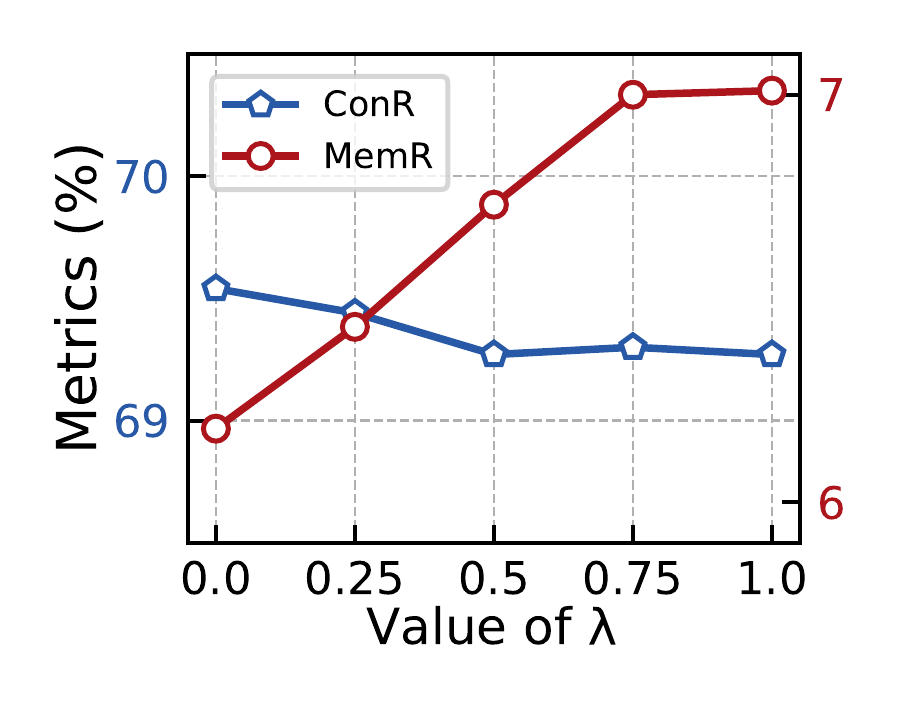
ConR and MemR versus suppression coefficient lambda from 0 to 1.
Suppression coefficient $\lambda$: smaller values lower MemR and raise ConR; full suppression ($\lambda=0$) works best.
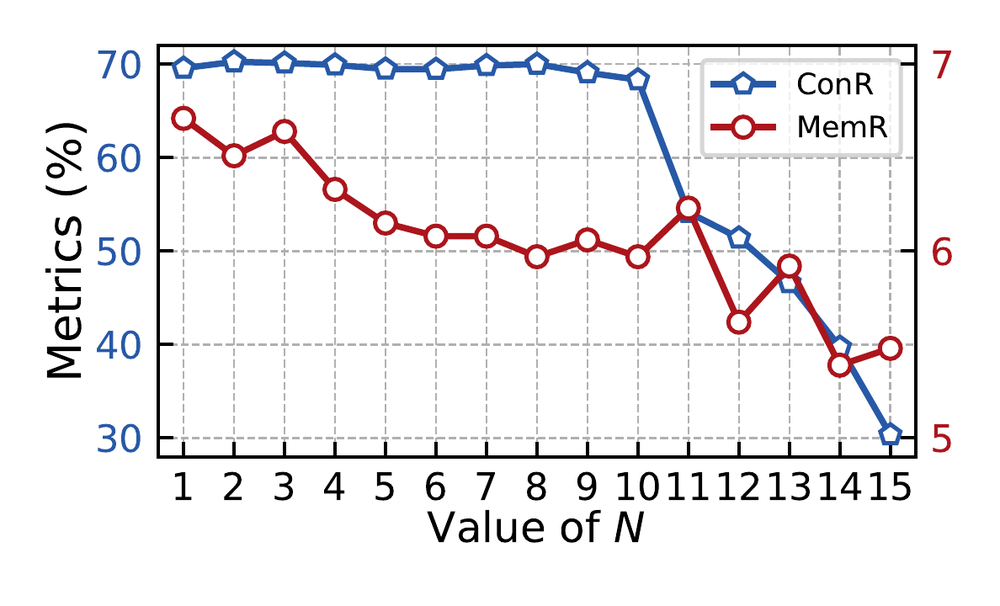
ConR and MemR versus number of suppressed FFN layers N from 1 to 15.
Number of suppressed layers $N$: more layers keep lowering MemR, but ConR drops sharply once $N$ reaches 10.
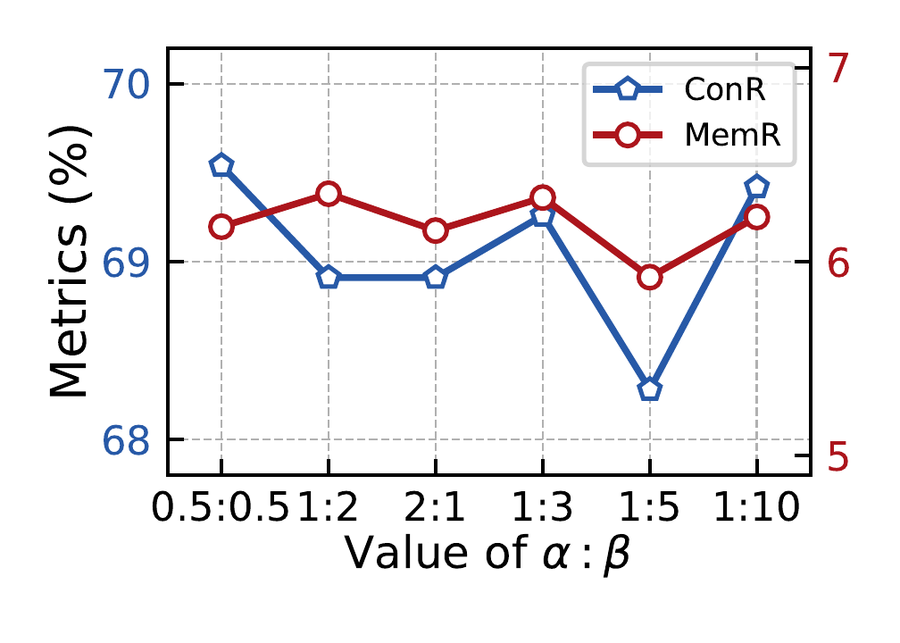
ConR and MemR for different alpha to beta ratios.
Loss weights $\alpha:\beta$ have limited impact; $\alpha=\beta=0.5$ gives a good balance.

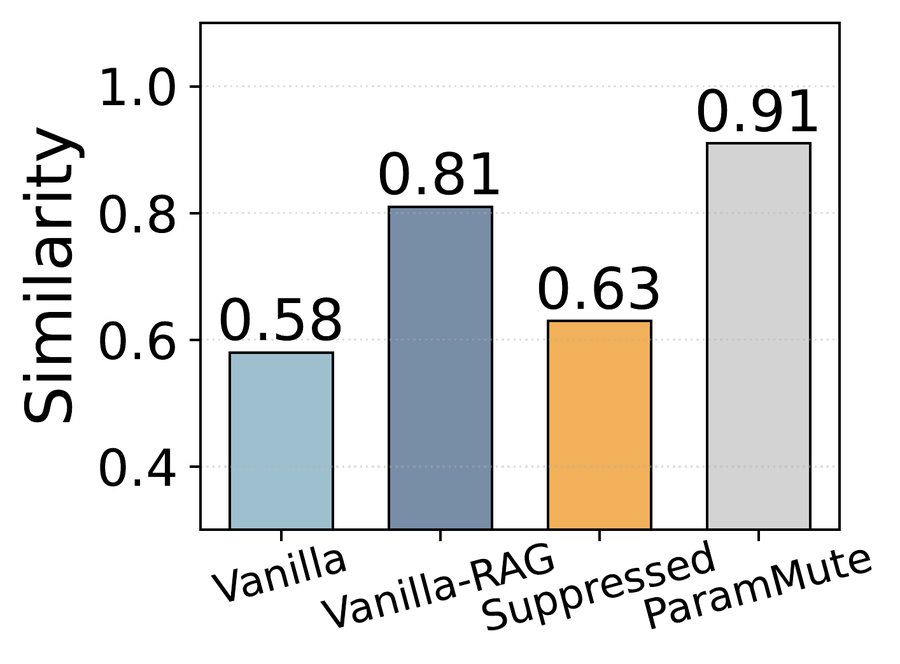
Does ParamMute change how the model uses knowledge?

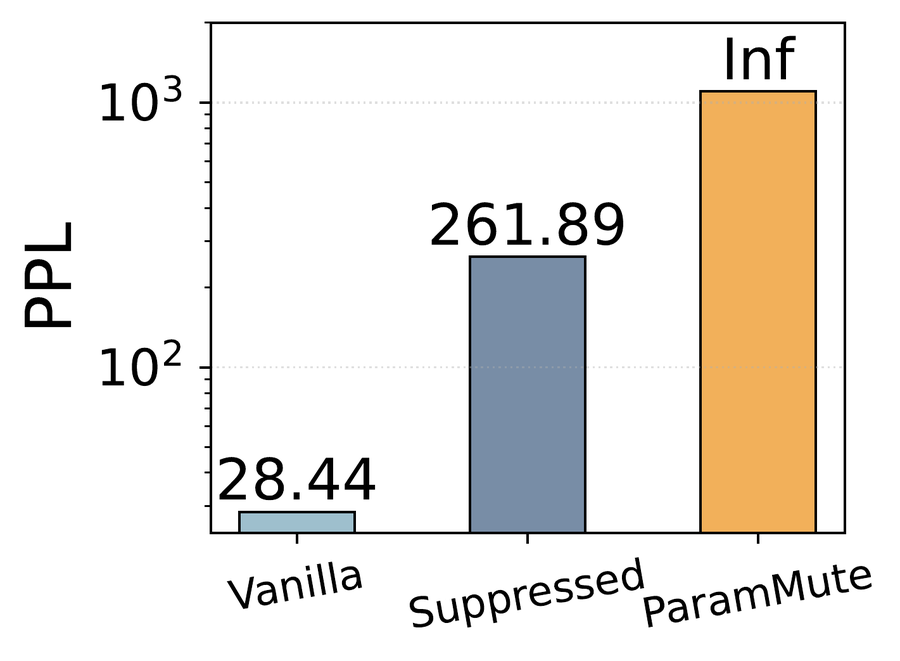
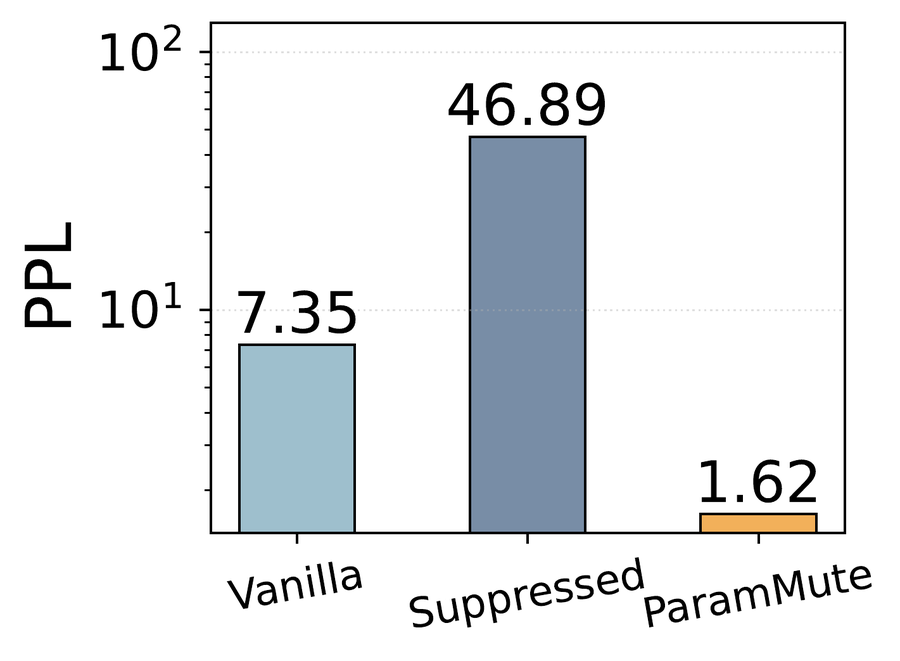
On the unfaithful subset $\mathcal{D}^-$ we compare the vanilla LLM, the Suppressed model (ParamMute without adaptation) and full ParamMute.

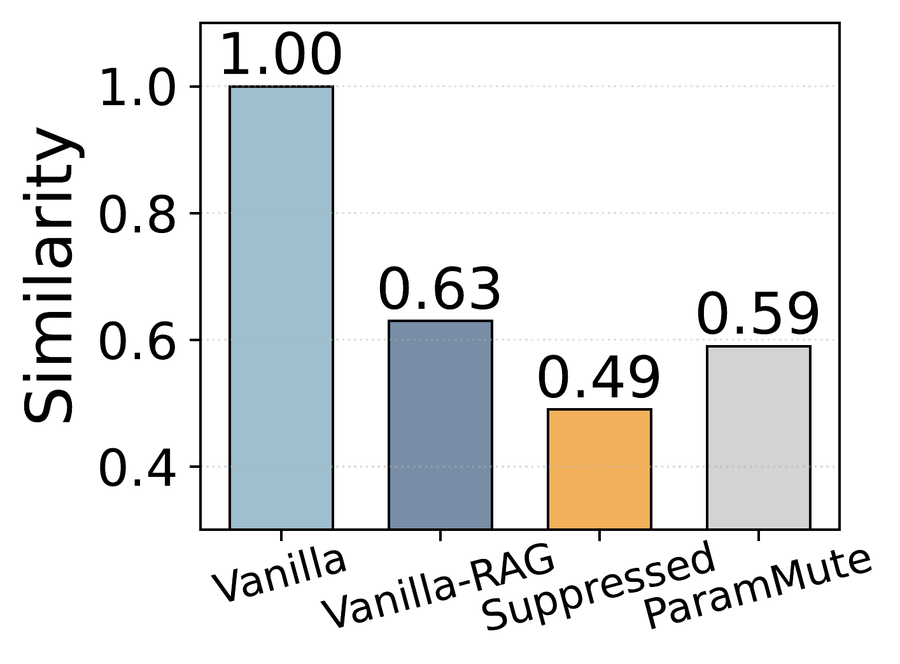
Similarity of responses with the parametric answer: Vanilla 1.00, Vanilla-RAG 0.63, Suppressed 0.49, ParamMute 0.59.
Similarity to the model's parametric answer: lowest for the Suppressed model (0.49).
Similarity of responses with the contextual answer: Vanilla 0.58, Vanilla-RAG 0.81, Suppressed 0.63, ParamMute 0.91.
Similarity to the contextual answer: highest for ParamMute (0.91 vs. 0.81 for vanilla RAG).
Perplexity of reproducing the ground-truth answer without context.
Perplexity of the ground-truth answer without context: suppression raises it, i.e. less reliance on memory.
Perplexity of reproducing the ground-truth answer with context.
Perplexity with context: ParamMute is confident only when the evidence is present.

FAQ

What is ParamMute?

ParamMute (Parametric Knowledge Muting through FFN Suppression) is a method from the NeurIPS 2025 paper by Pengcheng Huang et al. It makes retrieval-augmented LLMs answer from the retrieved evidence instead of conflicting internal memory by suppressing the feed-forward layers most associated with unfaithful answers and then training a small adaptation module that prefers context-grounded answers.

What are UA-FFNs?

Unfaithfulness-Associated FFNs: a small set of mid-to-deep feed-forward layers whose neuron activation ratio is higher for unfaithful responses than for faithful ones and correlates positively with unfaithfulness. Suppressing them increases the negative log-likelihood of unfaithful responses, which is evidence that they play a causal role.

How is ParamMute different from prompting, context-aware decoding, or DPO-style alignment?

Prompting (Attrprompt, O&Iprompt) and context-aware decoding (COIECD) work only on the input or output side; on CoFaithfulQA they tend to lower memory recall but also lower context recall. Fine-tuning and alignment baselines (SFT, KAFT, Context-DPO, DDR) adjust parameters but do not target where parametric knowledge is expressed. ParamMute first mutes the internal pathway (UA-FFNs) and then adapts the model, and it generally outperforms these baselines.

What is CoFaithfulQA, and how is it different from counterfactual benchmarks?

CoFaithfulQA is a benchmark introduced in the paper, built from NQ, SQuAD, NewsQA, TriviaQA, SearchQA and HotpotQA. Instead of injecting synthetic counterfactual contexts, it keeps questions where the model's own self-consistent closed-book answer genuinely conflicts with accurate evidence, as judged by both GPT-4o and GLM-4-plus. Its data is released on Hugging Face under the earlier name CoConflictQA.

Which models has ParamMute been tested on?

The main experiments use LLaMA3-8B-Instruct. The appendix applies ParamMute to LLaMA3.2-1B/3B-Instruct and Qwen2.5-0.5B, 1.5B, 3B, 7B and 14B-Instruct; it improves over vanilla RAG for every model. Larger models tend to rely more on parametric memory, and ParamMute brings their memory recall down.

Is ParamMute the same work as PIP-KAG?

Yes. Earlier arXiv versions of arXiv:2502.15543 were titled "PIP-KAG: Mitigating Knowledge Conflicts in Knowledge-Augmented Generation via Parametric Pruning". The NeurIPS 2025 version is titled "ParamMute: Suppressing Knowledge-Critical FFNs for Faithful Retrieval-Augmented Generation".
Where are the code and data?

Code: github.com/OpenBMB/ParamMute. Checkpoints, training data and the benchmark: the ParamMute collection on Hugging Face. Questions: pengcheng.neu@outlook.com.

中文简介

ParamMute:通过抑制知识关键的前馈层实现忠实的检索增强生成(NeurIPS 2025),第一作者为东北大学黄鹏程(Pengcheng Huang),通讯作者为刘正皓,合作单位包括清华大学、微软亚洲研究院和卡内基梅隆大学。

检索增强生成(RAG)中,即使检索到的文档准确且相关,大模型仍可能依据自身参数中记忆的知识作答,与上下文矛盾,这称为“不忠实生成”或知识冲突。论文发现,不忠实回答出现时,模型中后层的一小部分前馈网络(FFN)激活明显偏高,并通过相关性分析和因果干预验证了这一点,将这些层称为 UA-FFNs(与不忠实相关的 FFN)。

ParamMute 分两步:先抑制 UA-FFNs 的激活(LLaMA3-8B-Instruct 上抑制 8 层,系数 λ=0),削弱参数知识的干扰;再训练一个即插即用的适配模块,用知识增强训练和最大间隔的知识偏好损失,让模型更依赖外部证据。论文同时构建了 CoFaithfulQA 基准(Hugging Face 上名为 CoConflictQA),从 NQ、SQuAD、NewsQA、TriviaQA、SearchQA、HotpotQA 六个数据集中筛选模型自身知识与证据真实冲突的样本。

实验中,相比普通 RAG,ParamMute 在 CoFaithfulQA 上平均上下文召回率(ConR)提升 6.17 个点、参数记忆召回率(MemR)从 10.89 降到 6.18;在 ConFiQA 上 ConR 平均提升 54.63 个点。该工作的 arXiv 早期版本标题为 PIP-KAG。代码见 GitHub OpenBMB/ParamMute。

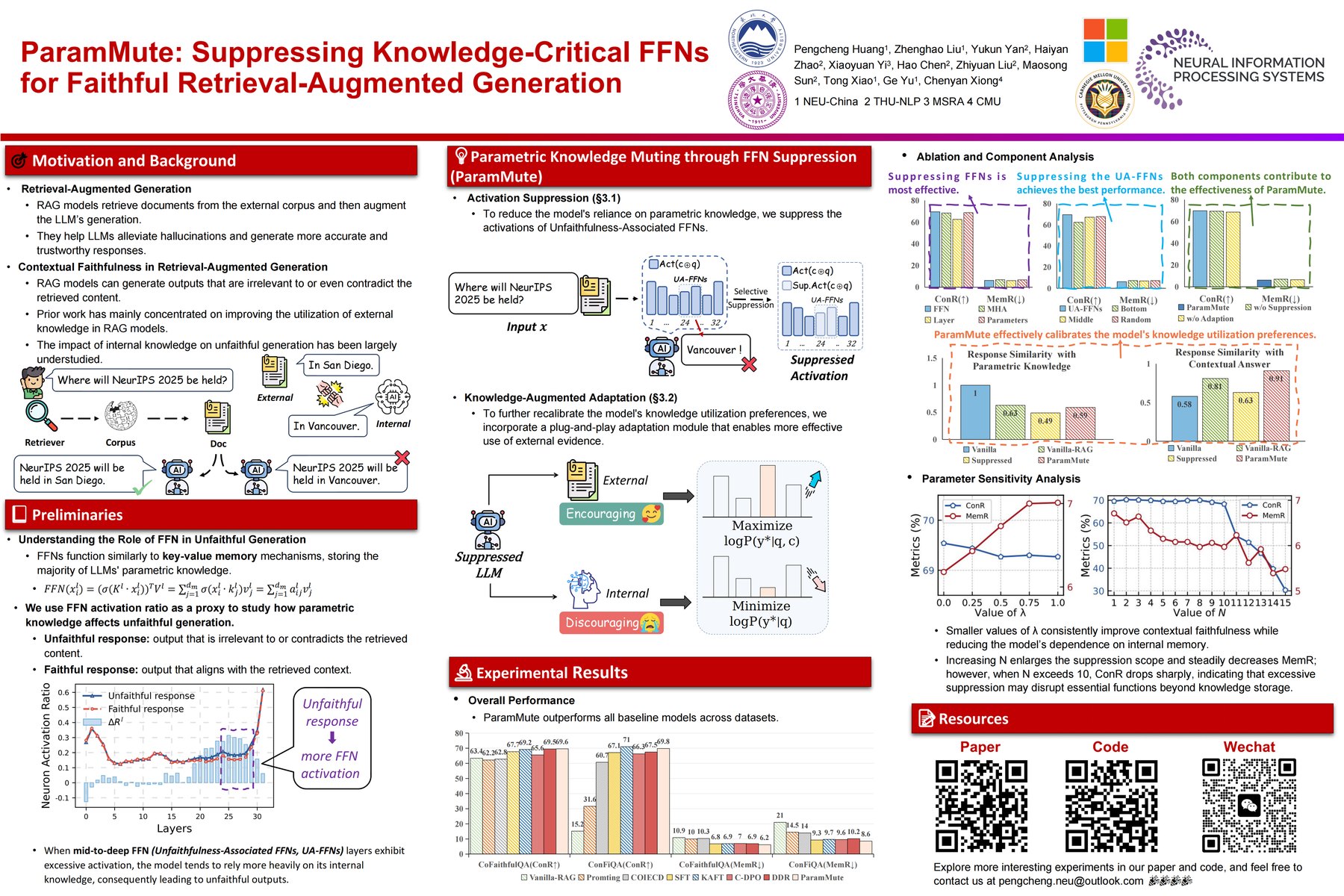
NeurIPS 2025 poster

ParamMute NeurIPS 2025 poster: motivation, FFN activation analysis, method, and results.
Click to zoom. Slides: NeurIPS 2025 slides (PDF) →

BibTeX

@inproceedings{huang2025parammute,
  title     = {{ParamMute}: Suppressing Knowledge-Critical {FFN}s for Faithful Retrieval-Augmented Generation},
  author    = {Huang, Pengcheng and Liu, Zhenghao and Yan, Yukun and Zhao, Haiyan and Yi, Xiaoyuan and Chen, Hao and Liu, Zhiyuan and Sun, Maosong and Xiao, Tong and Yu, Ge and Xiong, Chenyan},
  booktitle = {Advances in Neural Information Processing Systems},
  year      = {2025},
  url       = {https://openreview.net/forum?id=CyUq9D99vE}
}